2026-07-22
How Long Did David Take to Carve? Two Years, One Ruined Block, Zero Second Chances
Michelangelo carved David in about two and a half years, 1501 to 1504, from a block two sculptors had already abandoned. The full timeline of the Giant.
 By Luca Moretti, Florence Accademia Gallery guide and skip-the-line specialist

There is a spot at the front left of the Tribune where I stop every group I bring in. From there you catch the tilt of the neck and the slight overbalance of the weight onto the right leg, and sooner or later somebody asks the question I am waiting for: how long did this take him? I give the short answer, about two and a half years. Then I give the long one, because the block itself had been waiting for nearly forty, and it had already defeated two sculptors before a 26-year-old picked up a hammer.
How long did Michelangelo take to carve David?
About two and a half years of carving. The contract was signed in August 1501, Michelangelo started cutting into the marble that September at the age of 26, and the figure was essentially finished by the middle of 1504. Florence unveiled it beside the Palazzo Vecchio on 8 September 1504.
The commission came from the Operai, the board that ran the cathedral works, with the wool guild standing behind them. The terms, preserved in the contract records and summarized on Wikipedia's page on the statue, gave him two years at a salary of six florins a month. Like most deadlines attached to Michelangelo, that one bent. He worked through 1502 and 1503 largely out of public view in the cathedral workshop, and what he actually earned across those thousand days is a story of its own, which I unpack in what Michelangelo was paid for David.
| David, the working numbers | |
|---|---|
| Contract signed | 16 August 1501 |
| First blows on the marble | September 1501 |
| Michelangelo's age at the start | 26 |
| Carving finished | Mid-1504 |
| Unveiled at the Palazzo Vecchio | 8 September 1504 |
| Height of the finished figure | 5.17 m |
| Weight, including the base | About 5,660 kg |
The scale still ambushes people who know the statue only from photographs. Britannica lists the figure at 5.17 meters, which means the ankle you stand next to is roughly at your eye line. Two and a half years sounds long until you stand under what those years produced.
Why had the marble block already been abandoned twice?
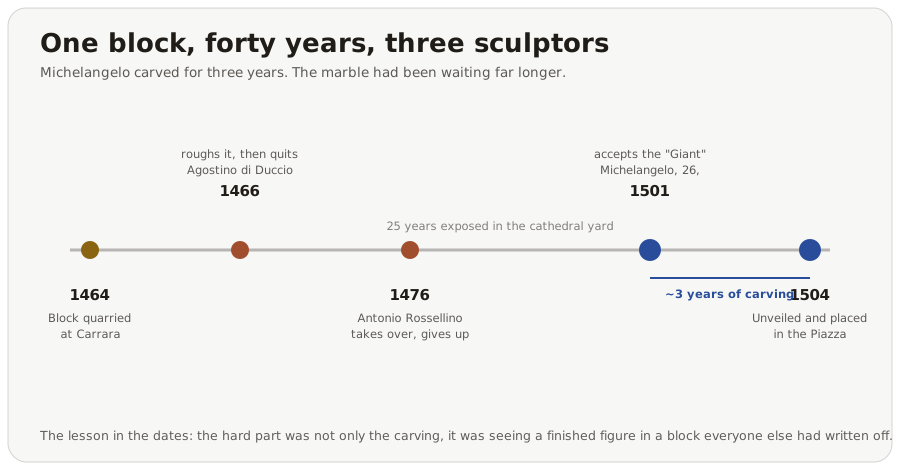
The block, a huge piece of Carrara marble the Florentines came to call "the Giant," was quarried decades earlier. Agostino di Duccio began a David from it in 1464 and stopped within two years. Antonio Rossellino took a contract in 1476 and gave up as well. The stone then lay in the cathedral yard for about 25 years.
Agostino got as far as the rough beginnings of the figure before his project stalled around 1466, and Rossellino's tenure in 1476 ended almost before it started. Nobody destroyed the block, because a monolith of that size was too rare and too expensive to waste, but nobody dared finish it either. An inventory taken around 1500 described, in the account preserved on Wikipedia, "a certain figure of marble called David, badly blocked out and supine." Badly blocked out and supine. A quarter century of Florentine rain had passed over it by then.
| Year | What happened to the Giant |
|---|---|
| 1464 | Agostino di Duccio is contracted and begins roughing out a David |
| 1466 | Work stops; the block is set aside |
| 1476 | Antonio Rossellino is contracted; the project stalls again |
| 1476-1501 | The block lies exposed in the cathedral workshop yard |
| August 1501 | Michelangelo, aged 26, wins the commission |
| September 1504 | The finished David is unveiled |
Why does one wrong blow ruin a marble statue?
Because carving is subtraction. Every stroke removes stone that nothing can put back, so a split ankle, a miscut wrist or a drill hole in the wrong place is permanent. Painters repaint and bronze founders recast. A marble carver gets exactly one version of every decision he makes.
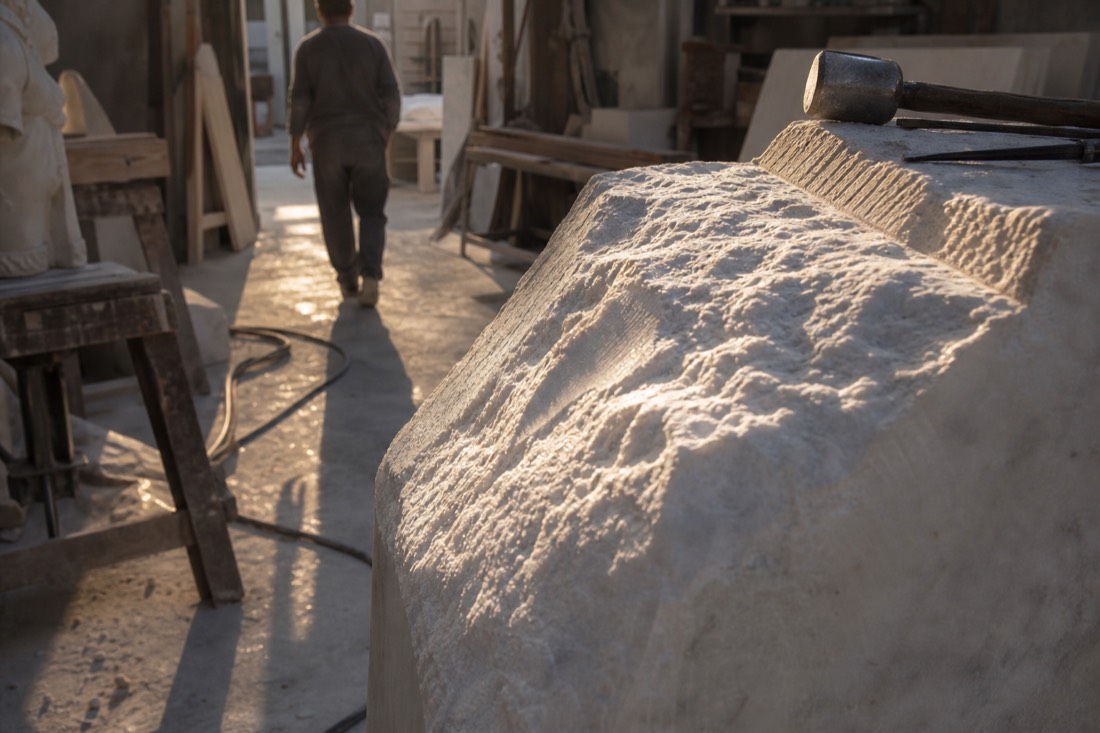
Now add the specific cruelty of this block. It had already been cut into by other hands, to someone else's design, and then weathered outdoors for 25 years. Michelangelo was not starting from a clean prism of stone; he was solving a damaged one, planning a five-meter figure around cuts he had not chosen. Every major form, the flared right hand, the sling over the shoulder, the gap between arm and torso, had to be found inside whatever sound marble remained.
That is why the two-and-a-half-year figure impresses me more the longer I guide here, not less. It was fast, and fast in a medium that punishes speed. If you want to see with your own eyes what happens when the subtraction stops halfway, it is forty steps away: the unfinished Prisoners line the corridor you walk to reach David, still half inside their blocks, the whole process caught mid-blow.
What happened to David after the carving stopped?
Florence convened a committee, with Leonardo da Vinci among its members, to decide where the statue should stand. Moving the figure from the workshop to the Piazza della Signoria took four days, the unveiling came on 8 September 1504, and David then stood outdoors in the square for nearly four centuries.
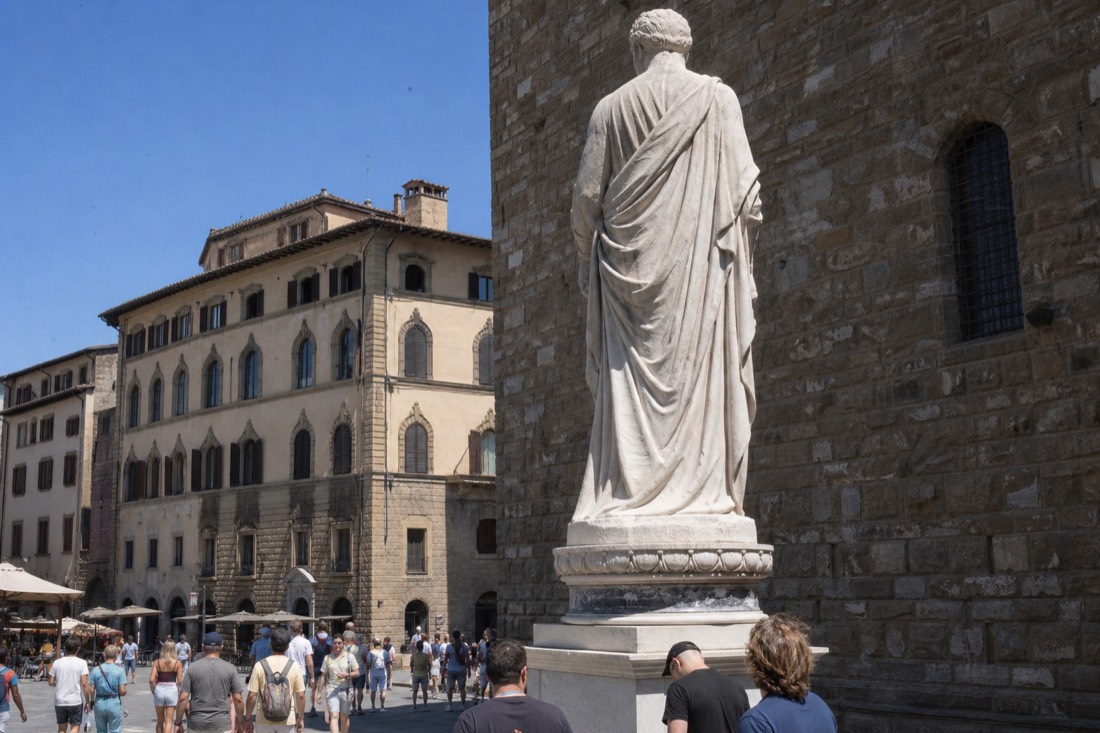
The move itself was an engineering feat: a figure weighing over five tons, inching half a mile through medieval streets in a wooden cradle. Then came 369 years of weather, pigeons and one riot, until the city moved the statue indoors to the Accademia in 1873 to save the surface. The marble David you see in the square today is a replica from 1910, and the bronze one on Piazzale Michelangelo went up in 1875. The original has stood under its purpose-built skylight ever since, which is why the light in the Tribune feels designed. It is.
Which is the whole point of coming: the copy in the square is not the trip.
What you are actually looking at once you get inside, the pose, the outsized right hand, the stare aimed at Rome, deserves its own walkthrough, and I give it one in my full guide to Michelangelo's David.
How do you plan a visit around the real thing?
Book a timed slot and come early. A full ticket costs 20 euros plus a 4 euro reservation fee, the gallery is closed on Mondays, and in spring the first slots of the morning are the ones that vanish first. The statue is the same all day. The crowd around it is not.
The current hours, prices and free days sit on the official visit page, and the honest queue math is simple: without a reservation the ticket line commonly runs 1 to 2 hours in season, while a timed slot leaves you only the security check, usually 10 to 20 minutes.
| Planning detail | The current picture |
|---|---|
| Opening | Tuesday to Sunday, 8:15 to 18:50, last admission 18:10 |
| Closed | Mondays, 1 January, 25 December |
| Full ticket | 20 EUR, plus 4 EUR reservation fee |
| Reduced, EU citizens 18-25 | 2 EUR |
| Under 18 | Free |
| Walk-up ticket line in season | Commonly 1-2 hours |
| With a timed slot | Security only, usually 10-20 minutes |
If you are weighing this museum against the other giant across town, my Uffizi vs Accademia comparison settles that fight honestly.
The Giant waited 37 years for the right pair of hands. You only have to wait for your time slot, and the early ones go to the people who book ahead.
Your Next Step
Check Your Florence Date
Accademia With An English Guide
Have your travel date in mind? See David with an English-speaking guide, then stay inside to explore independently. Check the start and meeting details before arranging your next stop.
65 minutes; admission and headsets included. Meet at Via Ricasoli 39, 15 minutes early. No hotel pickup, meals or luggage storage.
Initial editorial suggestion. Confirm the option, party requirements and final total before paying.
Scheduled departures load automatically. Final availability and price are confirmed on Viator.
A scheduled start is not a confirmed place. Your date is a planning aid; select it again on Viator.
No verified option fits those choices. Adjust the controls or reset to the general suggestions.
Compare Options And Fit This To Your Visit
Accademia With An English Guide: See David with an English-speaking guide, then stay inside to explore independently. 65 minutes; admission and headsets included. Meet at Via Ricasoli 39, 15 minutes early. No hotel pickup, meals or luggage storage.
Accademia Timed Entry: Explore David, the Prisoners and the other permanent rooms at your own pace. 60 minutes suggested; allow extra time for security. Meet at Via Ricasoli 45 blue, 15 minutes early; bring matching ID for every visitor. No live guide or luggage storage.
Accademia Entry And Audio Options: Choose an independent visit with a phone audio guide, or select a licensed guided option. About 1 hour. Permanent exhibitions included. Audio and guided inclusions depend on the option selected. Bring ID, a charged phone and headphones; arrive 10–15 minutes early at the option’s meeting point. Large bags prohibited.
Private Accademia Art Tour: Discuss David and the unfinished sculptures with your own art historian guide. 2 hours; admission included. Selected central hotels offer walking pickup, not a car transfer. Confirm your exact hotel or meeting point with the operator.
Affiliate links may earn us a commission at no extra cost to you. Booking is completed with the provider.