2026-07-22
The David Anatomy Questions Everyone Asks (Answered Like an Art Historian)
Why is David nude, why is the right hand so big, why do the proportions look strange up close? A Florence guide answers the real questions with real art history.
 By Luca Moretti, Florence Accademia Gallery guide and skip-the-line specialist

The questions always start in the same spot: halfway down the corridor of the Prisoners, the moment the tribune opens up and the marble catches the light from the skylight. Someone lowers their voice and asks why he is naked. Someone else asks why the hands look too big. I have guided over a thousand visitors through this room since 2022, and the anatomy questions come up on almost every single visit, usually whispered, always sincere. They deserve serious answers, because every one of them points at a real decision Michelangelo made. Here are the ones I hear weekly, answered the way I would answer a curious friend.
Why is David nude?
David is nude because Michelangelo worked inside the classical tradition of heroic nudity, where an idealized unclothed body stands for courage, virtue, and God-given human dignity rather than eroticism. Renaissance Florence had already revived that visual language, and David, facing Goliath with nothing but a sling and his faith, is its purest statement.
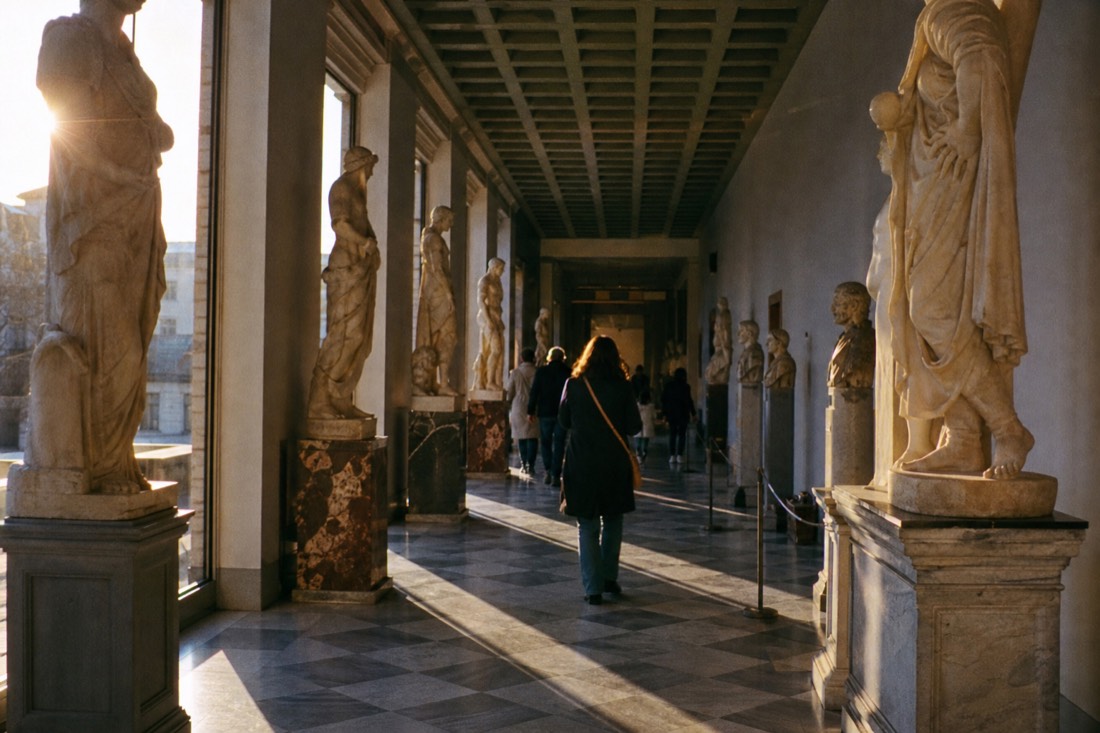
The Greeks carved their gods and athletes nude for roughly a thousand years before Florence existed, and the nudity meant excellence, not exposure. When Britannica describes the statue, it places it squarely in that revived classical line: a colossal nude hero, made for a city that saw itself as a new Athens. Michelangelo was not being provocative. He was being fluent in the most prestigious artistic language of his time.
He was not even the first Florentine to do it. Donatello's bronze David, the slight, dreamy youth standing over Goliath's severed head, had been nude since the mid-1400s and today lives a short walk away in the Bargello. Visitors who see both in one trip tell me the comparison reframes everything.
| Statue | Material and date | Moment shown | Where it stands |
|---|---|---|---|
| Michelangelo's David | Carrara marble, 1501-1504 | Before the fight, sling ready | Accademia tribune |
| Donatello's David | Bronze, mid-1400s | After the fight, over Goliath's head | Museo Nazionale del Bargello |
| Piazza della Signoria copy | Marble replica, 1910 | Same pose as the original | The statue's outdoor site until 1873 |
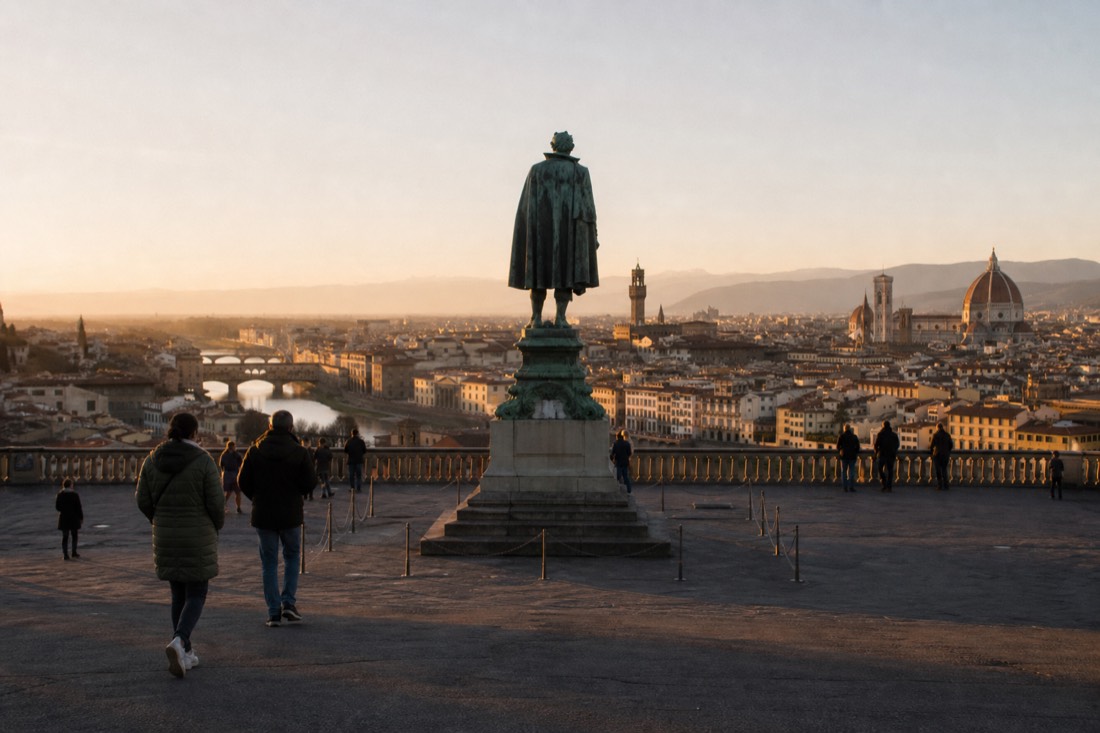
| Piazzale Michelangelo cast | Bronze, 1875 | Same pose, darkened metal | Panoramic terrace above the city |
The theology mattered too. David beats an armored giant while wearing nothing at all, which is exactly the point of the Bible story: no armor, no sword, just conviction. Clothing him would have blunted the sermon. Not everyone in 1504 agreed, and the statue's five centuries of fig leaves and protests are a story of their own, which I have collected in David's censorship stories.
Why is David's right hand so big?
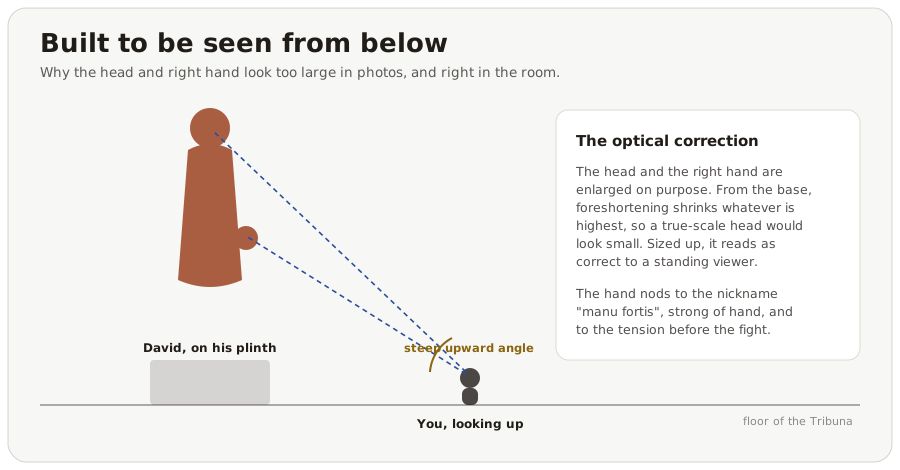
The right hand is oversized on purpose. The statue was planned for the cathedral's roofline, far above street level, so Michelangelo enlarged the hand and head to survive foreshortening from below. Seen at floor level in the Accademia, that correction reads raw: veins, tendons, and knuckles carved past strict anatomical scale.
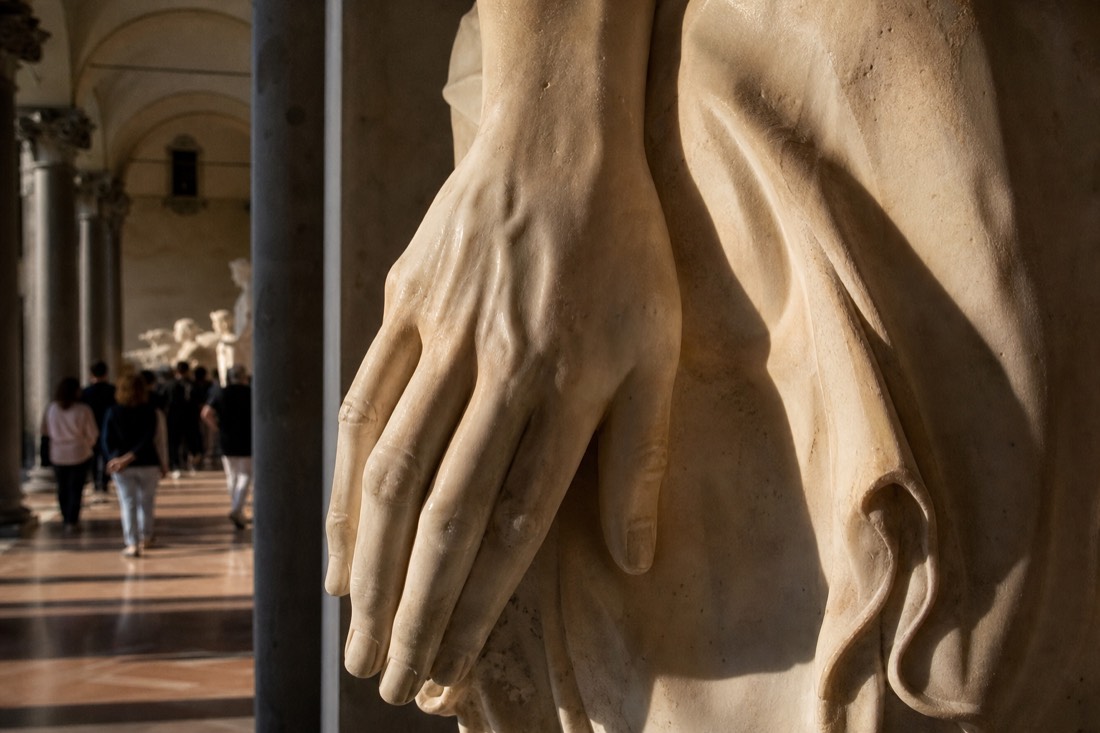
Stand at David's right side, his right, your left as you face him, and give the hand a full minute. The veins branch across the back of it, the tendons stand up, the knuckles are heavy as river stones. Guests sometimes assume the block forced Michelangelo's hand, so to speak, but the block explains nothing here. The commission history tells us the marble had been abandoned by two earlier sculptors and was meant for a buttress of Florence Cathedral, a perch high above anyone's eyes. At that distance a correctly scaled hand would have shrunk into a mitten. An enlarged one stays legible, and stays menacing.
There is also a narrative job being done. The hand holds the lower end of the sling, whose strap runs up across the back to the left hand at the shoulder. The whole violence of the story is compressed into that relaxed-looking grip, the calm before a stone flies. Michelangelo lets the anatomy carry the plot. And the exaggeration follows a hierarchy: the parts that speak, the head and the hands, get the emphasis, and the exact numbers behind that scaling are laid out in how tall David really is.
Whatever else it is, the hand is not a mistake. Nobody who could carve the wrist bones this precisely misjudged a proportion by accident.
Check the times offered for your date; neither availability nor a quiet room is guaranteed.
Why do David's proportions look strange up close?
Because you were never meant to stand this close. The head is large, roughly an eighth of the full height, the eyes are cut deep, and the upper body outweighs the legs, all of it tuned for a viewer far below. In the tribune you stand nearly level with the pedestal, so corrections built for distance read as distortion.
The basic facts are worth having in one place, and they are settled art history you can check against Wikipedia's well-sourced article:
| Vital statistic | Figure |
|---|---|
| Height | 5.17 m |
| Weight, statue with base | About 5,660 kg |
| Marble | A single Carrara block, abandoned by two earlier sculptors |
| Carved | 1501-1504 |
| Michelangelo's age at the start | 26 |
| Total payment | Roughly 400 florins |
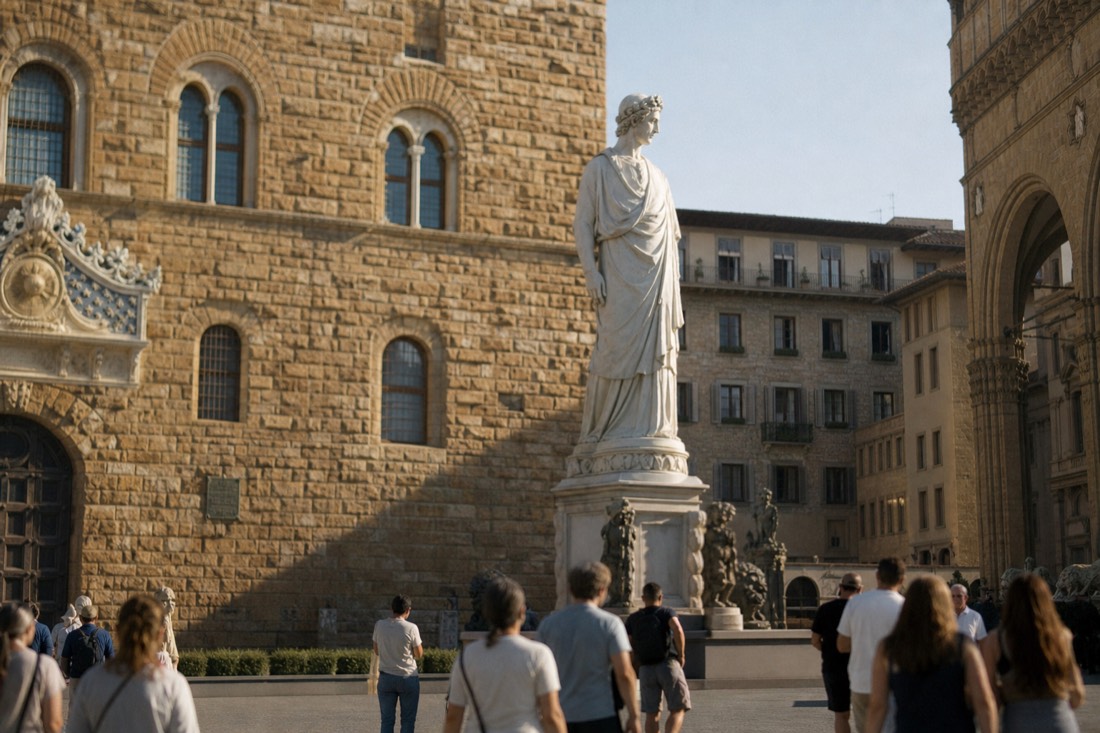
Now put those numbers on a cathedral buttress in your mind. From the street, foreshortening compresses everything above your sightline: heads shrink, faces flatten, shallow carving disappears. Michelangelo answered with deep undercutting around the brow and eyes, a heavier torso, and that famous hand. The plan changed, the statue went to Piazza della Signoria instead, and in 1873 it moved indoors to the Accademia, where we now inspect corrections meant for sixty feet of air from about sixty feet of floor.
What is David's body doing before the fight?
David is caught in the moment before the fight, not after it. His weight rests on the right leg in a classic contrapposto, the sling hangs slack over the left shoulder, and all the tension gathers in the neck, the brow, and the oversized right hand. Read him top to bottom and the calm slowly turns into threat.
This was the radical choice. Earlier Davids, Donatello's included, show the aftermath, a boy with a trophy head at his feet. Michelangelo picked the seconds before the stone flies, when the outcome is still faith rather than fact. The pose looks relaxed at a glance, hip cocked, arm loose. Then you reach the face and find the drawn brow and the sideways glare toward an enemy who is not in the room, and the whole body re-reads as a spring under load.
Here is how I walk guests through it, and it works best when you are not fighting a crowd, which is one honest reason the early slots matter:
| Where to stand | What you see | Why it matters |
|---|---|---|
| Far end of the Prisoners corridor | The full figure, small and distant | The closest thing to the intended faraway view |
| Straight on, at the rope | The gaze passing over your head to his left | You feel the target is behind you |
| His right side | The big hand, the veins, the sling's end | The compressed violence of the story |
| Slow clockwise circle | Shifting balance of tense and calm sides | The pose only resolves in the round |
Give this fifteen unhurried minutes. The room rewards patience more than any other room in Florence, and my full David guide covers the rest of the tribune, the Prisoners, and the quiet corners most visitors walk straight past. If you are still weighing this museum against the other giant, the Uffizi vs Accademia comparison settles that question honestly.
One last thing I tell every group before we leave the tribune. The anatomy questions are not embarrassing, and they were never trivial. Every oddity you noticed, the nudity, the hand, the heavy head, is a decision with five hundred years of argument behind it. Noticing them means you were actually looking, which already puts you ahead of half the room.
Your Next Step
Check Your Florence Date
Accademia With An English Guide
Have your travel date in mind? See David with an English-speaking guide, then stay inside to explore independently. Check the start and meeting details before arranging your next stop.
65 minutes; admission and headsets included. Meet at Via Ricasoli 39, 15 minutes early. No hotel pickup, meals or luggage storage.
Initial editorial suggestion. Confirm the option, party requirements and final total before paying.
Scheduled departures load automatically. Final availability and price are confirmed on Viator.
A scheduled start is not a confirmed place. Your date is a planning aid; select it again on Viator.
No verified option fits those choices. Adjust the controls or reset to the general suggestions.
Compare Options And Fit This To Your Visit
Accademia With An English Guide: See David with an English-speaking guide, then stay inside to explore independently. 65 minutes; admission and headsets included. Meet at Via Ricasoli 39, 15 minutes early. No hotel pickup, meals or luggage storage.
Accademia Timed Entry: Explore David, the Prisoners and the other permanent rooms at your own pace. 60 minutes suggested; allow extra time for security. Meet at Via Ricasoli 45 blue, 15 minutes early; bring matching ID for every visitor. No live guide or luggage storage.
Accademia Entry And Audio Options: Choose an independent visit with a phone audio guide, or select a licensed guided option. About 1 hour. Permanent exhibitions included. Audio and guided inclusions depend on the option selected. Bring ID, a charged phone and headphones; arrive 10–15 minutes early at the option’s meeting point. Large bags prohibited.
Private Accademia Art Tour: Discuss David and the unfinished sculptures with your own art historian guide. 2 hours; admission included. Selected central hotels offer walking pickup, not a car transfer. Confirm your exact hotel or meeting point with the operator.
Affiliate links may earn us a commission at no extra cost to you. Booking is completed with the provider.